Paraphrasing Is Not Plagiarism. Patchwriting Is.
Almost everyone who gets accused of plagiarism after “rewriting it in my own words” made the same mistake, and it is a narrow one. They changed the words but kept the sentence, and they either cited it late or not at all.
Table of Contents
ToggleA paraphrase is a legitimate, expected academic and editorial skill. It becomes plagiarism when one of three things is missing:
- Attribution. The idea came from somewhere, and the reader cannot see where. Rewording does not transfer ownership of an idea.
- Reconstruction. You swapped synonyms into someone else’s sentence structure. This is called patchwriting, and most institutions treat it as plagiarism even when a citation is present.
- Understanding. You could not restate the point without the source open in front of you, which is why the original structure survived in your version.
This guide gives you the working method for all three, the citation rules that actually get tested, and — because 2026 added a second problem — how to keep your own honest writing from being flagged as AI. All of it is free and none of it requires a tool.
The Four Outcomes, Ranked From Safe to Career-Damaging
What you produced
What it looks like
Verdict
Direct quote, quoted and cited
Exact words in quotation marks with a citation
Safe, but use sparingly — heavy quoting reads as thin analysis
True paraphrase, cited
New structure, new words, same meaning, citation attached
Safe. This is the target
Patchwriting, cited
Same sentence skeleton, synonyms swapped, citation attached
Usually treated as plagiarism, even with the citation
Any paraphrase, uncited
Reworded idea presented as your own
Plagiarism
AI-spun rewrite of a source
Passed through a rewriter or “humanizer”
Plagiarism risk, AI-detection risk and factual drift, all at once
A worked example
ORIGINAL SOURCE SENTENCE
“Cities that expanded their tree canopy by ten per cent recorded afternoon surface temperatures roughly two degrees lower than comparable districts without new planting.”
PATCHWRITING — UNSAFE, EVEN WITH A CITATION
“Cities that grew their tree cover by ten per cent registered afternoon surface temperatures about two degrees cooler than similar districts lacking new planting.”
A TRUE PARAPHRASE — SAFE, WITH A CITATION
“Adding trees appears to pay off quickly in surface heat: a ten per cent increase in canopy was associated with afternoon surface temperatures about two degrees below those of otherwise similar neighbourhoods (Author, 2025).”
In the middle version every noun has a synonym and the sentence is otherwise untouched: same order, same clause structure, same rhythm. Nothing has been understood, only relabelled. In the third version the idea order is inverted, the finding is reframed as a relationship rather than a comparison, the clause structure is rebuilt, and the source is credited at the point of use.
The 5-Step Close-The-Source Method
This takes about ninety seconds per passage once you are used to it.
- Read it twice, then close it. Not minimise — close. If the source is visible, your fingers will copy its structure without your permission.
- Say it in one sentence, out loud. If you cannot, you do not understand it yet, and no amount of rewording will hide that. Go back and read it again.
- Rebuild, do not resurface. Change at least two of: the order of the ideas, the sentence type (statement to question, list to prose, cause to effect), and the level of abstraction (specific example to general principle, or the reverse).
- Keep the terms of art, change everything else. “Photosynthesis”, “gross margin” and “tree canopy” cannot be reworded and should not be. Precision terms stay; connective prose is yours to write.
- Cite first, then compare. Attach the citation before you reread the original side by side. Then check five markers: no unquoted string of more than four consecutive words, different clause order, different sentence boundaries, no borrowed metaphors, and the meaning unchanged.
The four-word rule of thumb. Four or more consecutive words lifted from a source belong in quotation marks. It is not a legal standard, but it is close to what similarity software flags and close to what a reader notices.
When You Still Have to Cite (Even After a Perfect Paraphrase)
What you are using
Cite it?
Notes
A paraphrased argument or finding
Yes
The words are yours; the idea is not
A summary of a whole paper or chapter
Yes
One citation at the start, not buried at the end of the section
Exact wording
Yes, plus quotation marks
Reword or quote — never half of each
Statistics, tables, figures, datasets
Yes
Include the page, table or figure number
A structure or framework you borrowed
Yes
Borrowed frameworks are cited even when every word is yours
Facts “everyone knows” in your field
Usually not
If three general sources state it without a citation, it is common knowledge
Your own earlier submitted work
Yes
Reusing it uncited is self-plagiarism at most institutions
AI-generated text or AI-assisted edits
Follow your policy
Disclosure requirements vary and are being rewritten constantly — check the current version, not last year’s
Why Plagiarism Checkers Miss Paraphrased Content
Most plagiarism software is fundamentally a string-matching engine. It fingerprints your text, compares those fingerprints against an index of web pages, publications and past submissions, and reports overlapping strings as a similarity percentage.
That design has two consequences people misread constantly:
- A low similarity score is not a clean bill of health. Patchwriting frequently returns single-digit similarity, because a synonym swap breaks the string while leaving the theft intact.
- A high similarity score is not an accusation. Correctly quoted material, reference lists and standard method sections all inflate the number without any misconduct.
Semantic and paraphrase-aware detection — comparing meaning and structure rather than exact strings — catches more of the middle ground, but it produces judgement calls rather than proof. Which is exactly how you should read any score you are shown.
The 2026 Problem: AI Rewriters Create Two Risks at Once
Running a source through a paraphrasing tool, a “humanizer”, or an AI rewrite feature feels like a shortcut. It creates three separate exposures:
- The attribution problem does not go away. A machine-reworded source is still an uncited source. Tools rewrite; they do not attribute.
- Meaning drifts. Rewriters routinely soften hedged claims, invert conditionals, and turn “was associated with” into “caused”. You then own that error under your name.
- You inherit an AI signature. Heavy AI editing of genuinely human writing can push it over a detector’s threshold. Originality.AI’s own documentation notes that AI-based rewrite features — including some Grammarly rewrite functions — can trigger false positives, and that scans shorter than roughly 100 words are unreliable.
The practical rule: use AI to question your draft (“what am I missing here?”, “is this claim overstated?”) rather than to produce it. Questioning leaves no signature. Production does.
How to Protect Honest Writing From a False Positive
Independent evaluations of AI detectors report detection rates broadly in the low nineties and false positive rates ranging from around one per cent to well into double digits, depending on the tool, the text type and the sample. Several studies also find that writing by non-native English speakers is flagged disproportionately often, because it tends toward the regular, hedged, formulaic patterns that detectors associate with machine text.
You cannot control that. You can control the evidence trail:
- Draft in one document with version history on — Google Docs or Word with autosave. A visible edit history is the single strongest piece of evidence a writer can produce.
- Keep the mess. Outlines, false starts, research notes, half-written paragraphs. Clean writing with no visible process looks worse than messy writing with one.
- Never paste finished prose from a chat window into your draft, even your own rewritten version. Retype what you want to keep.
- Save your sources as you go, not at the end. Reconstructed reference lists are where accidental plagiarism enters.
- Check the policy before the deadline, not after the accusation. Disclosure rules for AI assistance differ by institution and by publisher.
If you are accused: ask which tool was used, what threshold was applied, and whether the result was reviewed by a person. Then show your version history. An AI score is a probability, not a fingerprint, and no responsible policy treats it as sole evidence.
Where Doing It Yourself Stops Being Enough
Everything above works and costs nothing. The gap shows up at the point of submission, and it is always the same gap: you cannot see what the person on the other side will see. Your professor, editor or client is going to run a scan you have no visibility into, and “I wrote it myself” is an assertion, not evidence.
That is a verification problem, not a writing problem, and it is worth solving before the accusation rather than after. If you want to check your own work with the same class of tool that is likely to be run on it, Originality.AI is the one I would point a serious writer to — it combines AI detection, plagiarism checking, and, unusually, a way to demonstrate authorship rather than just argue for it.
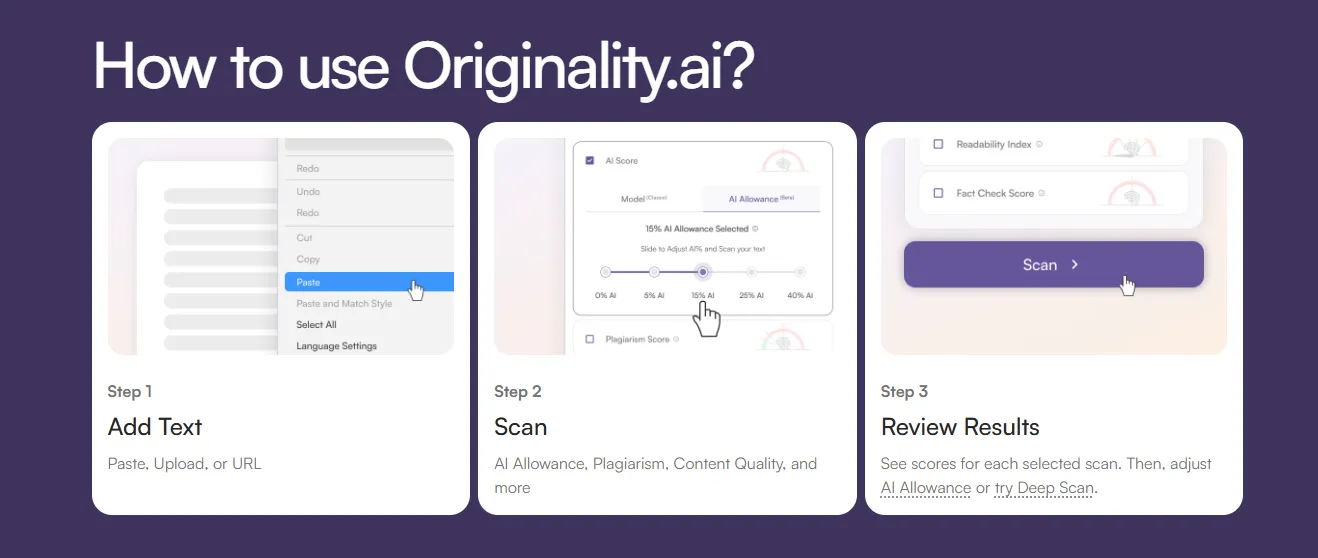
What it actually does, in plain terms:
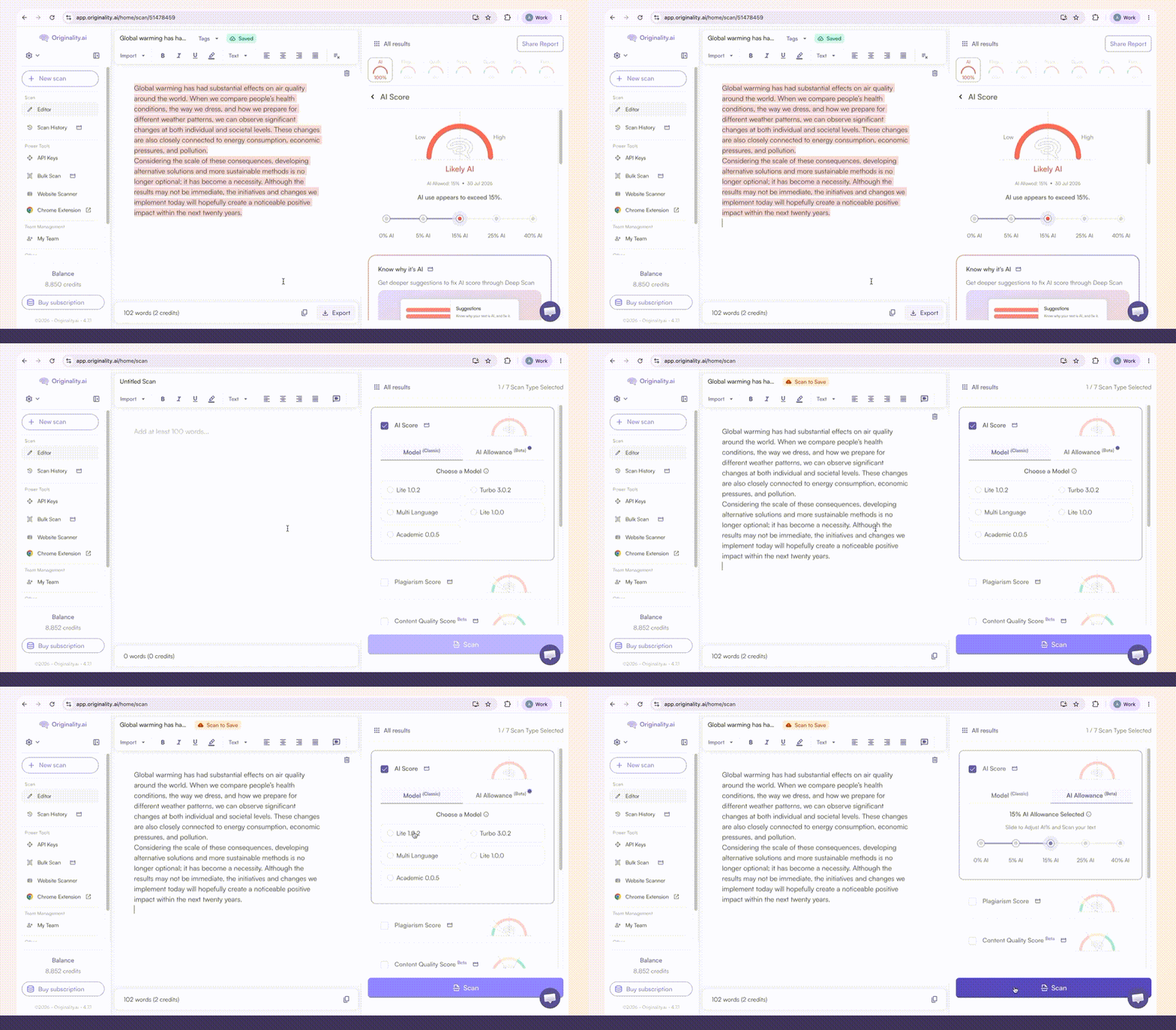
- AI detection with an adjustable AI Allowance — you set how much AI assistance your project or classroom permits, and the result is read against that line instead of a fixed pass/fail.
- Plagiarism checking in the same pass, so paraphrase problems and AI signal surface together rather than in two separate tools.
- Writer Replay in the Chrome extension — a sped-up, character-by-character replay of how a Google Doc was actually written, plus auto-typing detection that distinguishes natural typing from a script pasting text. This is the feature that matters most if you are the accused rather than the accuser: it converts “trust me” into a shareable, read-only report.
- Works where you write — Google Docs and Chrome, with a Moodle plugin and an API for institutions and publishers.
- Multilingual scanning, which the vendor states covers 30 languages.
Be honest about the limits, because they matter here. Originality.AI’s own published study claims accuracy around 99 per cent; independent benchmarks and peer-reviewed evaluations generally place it lower, roughly 91–94 per cent detection with false positive rates of about two to seven per cent depending on the test set. It is one of the stronger tools in a category that is inherently probabilistic. Treat every score — including a favourable one — as evidence to be weighed, never as a verdict.
The link below is an affiliate link — if you buy through it, I earn a commission at no extra cost to you. Full disclosure at the bottom of this page.
Run a free AI and plagiarism check on your own draft before someone else does.
Free AI checker for short texts · paid plans start at $14.95/month · no ongoing free tier for plagiarism scans
What It Costs, and What the Free Version Actually Covers
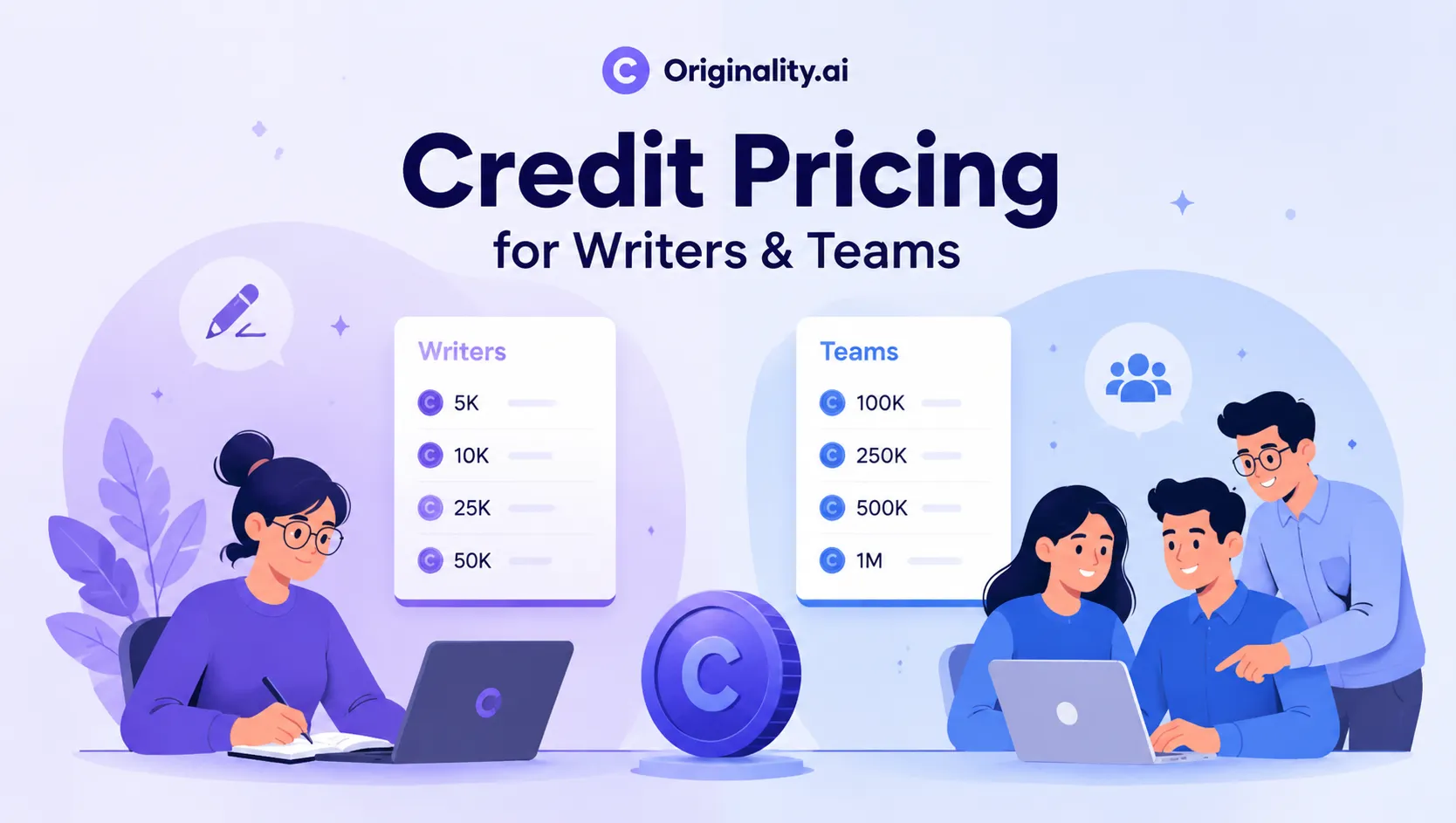
Pricing below is taken from the vendor’s public pages at the time of writing (August 2026) and changes without notice — confirm before you buy. Credits are the unit of account: roughly one credit per 100 words for an AI scan, with plagiarism checks consuming additional credits.
Option
Price
What you get
Best for
Free AI checker
$0
Up to 2,000 words per scan, about three scans a day, 100-word minimum. No plagiarism check, no shareable report
A student checking one essay before submitting
Pay as you go
$30 one-time
3,000 credits (about 300,000 words of AI scanning), valid two years
Freelancers with irregular volume
Pro
$14.95/month, or $12.95/month billed annually ($155.40/year)
2,000 credits per month, plagiarism checker, readability, fact and content-quality checks, team management
Regular writers, editors, small content teams
Enterprise
$136.58/month billed annually
Much larger credit allowance, API access, team roles, priority support
Publishers, agencies, schools
Worth it if: you submit work that can be rejected or penalised on an AI score; you hire or commission writers and need a defensible QA step; you are an ESL writer who has been flagged before and wants a process record; or you publish at volume and a single plagiarism incident would cost more than a year of the subscription.
Skip it if: you need one check, once — use the free scan; your institution runs Turnitin and will not accept third-party reports, in which case ask what they accept before you pay; you write fiction or personal essays with no attribution stakes; or you are hoping a tool will tell you how to get AI text past a detector, which is not what this is for and not a game worth playing.
Compare the current plans and credit pricing before you commit.
Pay-as-you-go from $30 · credits valid two years · cancel subscriptions anytime
Frequently Asked Questions
Is paraphrasing plagiarism?
No — paraphrasing is a normal and expected part of academic and professional writing. It becomes plagiarism when the source is not credited, or when the “paraphrase” is really the original sentence with synonyms substituted. The test is whether you rebuilt the idea in your own structure and told the reader where it came from.
How much do I have to change for it not to be plagiarism?
There is no percentage threshold, and any tool promising one is selling you a false standard. Practically: no run of four or more consecutive words from the source outside quotation marks, a different clause order and sentence structure, and a citation at the point of use. If a reader could line your sentence up against the original word for word, you have not changed enough.
Can plagiarism checkers detect paraphrased content?
Traditional string-matching checkers often miss it, which is exactly why patchwriting is so common and so dangerous — it can return a low similarity score while still being misconduct. Paraphrase-aware and semantic tools catch considerably more, but they return judgement calls rather than proof.
Will an AI detector flag writing that is genuinely mine?
It can. Reported false positive rates range from around one per cent to well into double digits depending on the tool and the text, and formulaic or non-native English writing is flagged more often. Short texts are the least reliable of all — most tools, Originality.AI included, need roughly 100 words before a score means anything. Keep version history as your defence.
Is using an AI paraphrasing tool cheating?
That depends on your institution or client, and the policies are changing fast — check the current wording rather than assuming. Two things are true regardless: a machine-reworded source still needs a citation, and heavy AI rewriting can push honest work over a detector’s threshold. Use AI to interrogate your draft, not to generate it.
Do I need a paid checker, or is a free AI detector enough?
If you check one document occasionally, the free scan is enough. Paid tools earn their price when you need plagiarism checking in the same pass, a shareable report someone else will accept, or proof of authorship such as a writing replay — in other words, when the cost of being wrongly accused is higher than the subscription.
Verdict
The line between paraphrasing and plagiarism has never really been about vocabulary. It is about whether you rebuilt the idea and whether you said where it came from. Close the source, say it in one sentence, rebuild the structure, keep the technical terms, cite at the point of use — that method alone will keep the overwhelming majority of writers out of trouble, and it costs nothing.
What is new is that being honest is no longer automatically enough to look honest. Draft with version history on, keep your mess, and if the stakes are real, verify your own work before someone else does it for you.
Check your draft for AI signal and plagiarism, and keep a record that shows how it was written.
AI detection + plagiarism + writing replay · free AI checker available · paid plans from $14.95/month
Affiliate Disclosure
Some links on this page are affiliate links. If you click one and subscribe, I may receive a commission from the vendor. This never changes the price you pay and never affects what this page says. Pricing, credit allowances and features are taken from publicly available vendor information in August 2026 and may change without notice. Accuracy figures attributed to the vendor are the vendor’s own published claims and have not been independently verified here; independent evaluations report different figures. AI detection is probabilistic: no tool, including the one recommended here, can prove authorship with certainty, and an AI score should never be used as the sole basis for an academic or employment decision.