Start With the Question Everyone Skips
Almost every comparison of these two tools opens with accuracy. That is the least useful place to start, for a simple reason: most people reading this do not get to choose.
Table of Contents
ToggleTurnitin is sold to institutions. Schools, universities, and some publishers buy a licence, wire it into their learning management system, and every submission passes through it. You do not install Turnitin. You are scanned by it.
Originality.ai is sold the other way around — to individuals, freelancers, agencies, publishers and content teams. You sign up, you pay, you scan your own work or your writers’ work. You scan with it.
So before comparing detection rates, work out which sentence describes you:
If you are…
The tool that applies to you
What you actually control
A student at a school with a Turnitin licence
Turnitin, whether you like it or not
Only your evidence trail — not the tool, the threshold, or the review process
A teacher at that school
Turnitin, through your institution
How you interpret a score, and whether you talk to the student before acting
A freelance writer or ghostwriter
Whatever your client runs — often Originality.ai
Your own pre-delivery check and your proof of authorship
A blog owner or publisher hiring writers
Originality.ai or a similar commercial tool
Everything: the tool, the threshold, the workflow
An agency managing dozens of writers
Originality.ai class of tool, or an enterprise contract
Team roles, bulk scanning, and your QA standard
A school choosing a system
Both are on the table
A procurement decision that will affect thousands of people
If you landed here as a student or a writer who has been accused of something, the honest answer is that this is not really a shopping decision. Skip to “Accused by a Tool You Cannot Access” below — that section is the one written for you.
What Each Tool Actually Is
Turnitin
Originality.ai
Primary buyer
Institutions: schools, universities, some publishers
Individuals and businesses: writers, freelancers, agencies, publishers
How you get access
Through your institution’s licence, usually inside an LMS
Self-serve signup, credit card required
Original purpose
Similarity checking against a huge submissions archive
Content quality control for web publishers, later extended to academic use
Similarity / plagiarism
Core product, with an archive of past student submissions that no competitor can replicate
Yes, in the same scan as AI detection
AI detection
Added later, deployed at institutional scale
Core product, with selectable models and an adjustable AI Allowance
Paraphrase and patchwriting
Detected to a degree; historically the known weak spot of string-matching engines
Marketed specifically at paraphrase and patchwork plagiarism
Writing-process evidence
Not the product’s job
Chrome extension writing replay plus auto-typing detection
Where it lives
Inside the assignment workflow — Moodle, Canvas, Blackboard and similar
Web app, Chrome, Google Docs, Moodle plugin, API
Report you can share
Generated for the institution, not for you
Exportable PDF report you can hand to a client or reviewer
Public per-seat price
Not published — quoted per institution
Published: from a free tier up to enterprise plans
The single most important row in that table is the last but one. Turnitin produces evidence for the institution. Originality.ai can produce evidence for the writer. Everything else in this comparison follows from that difference.
Who Can Actually Buy Each One
This is the part most “X vs Y” articles quietly skip, because it makes the comparison look lopsided — and it is.
- An individual student generally cannot buy a Turnitin licence. Some institutions expose a self-check option before final submission; many do not. If yours does, use it, because that is the exact engine your work will be judged by.
- An individual teacher usually cannot buy one either. Access comes from the department or the institution, not the classroom.
- A freelancer or publisher has no realistic path to Turnitin at all, which is precisely the gap commercial detectors fill.
- Anyone can buy Originality.ai, including a student — although the vendor states plainly that the product is built for publishers, agencies and writers rather than for students, and a credit card is required at signup.
So in practice, this is rarely a head-to-head purchase. It is two different markets that happen to measure similar things, and the overlap only becomes a real decision in one place: a school or publisher deciding what to standardise on.
Accuracy: Vendor Claims and Independent Findings Are Not the Same Thing
🔍 How to read every number in this category. Both companies publish their own accuracy research, and both look excellent in it. That is not evidence of dishonesty; it is what happens when a vendor selects the test set. Independent benchmarks consistently produce lower and messier figures than vendor pages do, and the gap is not small. Treat any single number — from either side — as a claim with a date and a test set attached, not as a property of the tool.
What can be said with reasonable confidence:
- Both vendors publish favourable first-party results. Originality.ai’s own studies report accuracy around 99 per cent with false positive rates around one to two per cent, depending on the model selected. Turnitin likewise publishes its own figures and has revised its public guidance more than once as its detector matured. Neither set of numbers is independent.
- Independent benchmarks land lower. Third-party reviews and academic evaluations of commercial detectors typically report real-world accuracy well below the marketing figures, with performance varying sharply by text type, length and how heavily the text was edited.
- Paraphrased and rewritten text is the hard case for everyone. Running AI output through a rewriter is the standard way detection is evaded, and it is where detector performance diverges most. Originality.ai has scored strongly on paraphrase-focused benchmarks; some other tools return near-zero detection on the same category.
- False positives are not evenly distributed. A widely cited 2023 Stanford-affiliated study found that detectors of that era flagged roughly 61 per cent of TOEFL essays written by non-native English speakers as AI-generated. A 2025 University of Chicago Booth working paper evaluating current commercial detectors found the best of them holding false positive rates at or below one per cent on academic writing, while an open-source baseline flagged between 30 and 69 per cent of human text. The spread between tools is enormous, and it changes every time a new model ships.
- Short text is unreliable in every tool. Roughly 100 words is the practical floor below which no score means much, and both vendors say so in their own documentation.
Three honest conclusions follow. Detection has improved and is not useless. Every published percentage is scoped to a date, a model generation and a sample. And no score, from either tool, is a fingerprint.
Where Each One Genuinely Wins
Situation
Better fit
Why
Grading a class of 200 assignments inside an LMS
Turnitin
Built into the assignment workflow, and the submissions archive catches student-to-student copying nothing else can see
Catching a passage recycled from a past student’s paper
Turnitin
That archive is genuinely unmatched — no commercial tool can compare against it
Vetting an article from a freelance writer before publishing
Originality.ai
Turnitin is not available to you, and AI plus plagiarism plus readability arrive in one pass
Auditing hundreds of existing pages on a website
Originality.ai
Bulk and site-wide scanning is a publisher feature, not an academic one
Proving that you personally wrote a draft
Originality.ai
Writing replay and auto-typing detection produce a shareable artefact; a similarity report cannot do this
Setting a defensible AI policy for a whole institution
Turnitin, plus human review
Institutional deployment, audit trails and appeals processes matter more than raw detection here
An ESL writer who keeps getting flagged and wants to see it coming
Originality.ai
You can run the scan yourself, before someone else does
Deciding whether to fail or discipline someone
Neither, alone
Both produce probabilities; the decision requires a person, a conversation and evidence
Accused by a Tool You Cannot Access
This is the scenario that generates the most desperate search traffic, and the one both vendors’ marketing pages handle least well. A student or writer is told a score says their work is AI-generated. They did write it. They cannot see the tool, the threshold, or the model version, and they are expected to disprove a number.
The most widely reported case of this kind involved a student who used Grammarly for proofreading, was flagged, received a zero, and faced academic consequences. Whether or not any individual case was handled correctly, the pattern is clear enough that both vendors now publish guidance on false positives, and Originality.ai’s own help documentation notes that AI-based rewrite features — including some Grammarly rewrite functions — can trigger them.
What actually helps, in order of usefulness:
- Draft in one document with version history switched on. Google Docs or Word with autosave. A visible, gradual edit history is the strongest evidence an individual can produce, and it costs nothing.
- Keep the mess. Outlines, abandoned paragraphs, research notes, wrong turns. Clean writing with no visible process looks worse than messy writing with one.
- Never paste finished prose from a chat window, even your own rewritten sentences. Retype what you want to keep.
- Ask three questions. Which tool was used, what threshold was applied, and did a person review the result before a decision was made.
- Ask what the policy actually says about AI-assisted editing and grammar tools, in its current wording rather than last year’s.
And the line worth remembering, because responsible policies at both vendors say versions of it: an AI score is a probability, not proof, and it should never be the sole basis for an academic or employment decision.
What Schools Should Weigh Before Standardising on Either
- Coverage of the risk you actually have. If the dominant problem is copying between students, the submissions archive matters more than any AI percentage. If it is undisclosed AI drafting, the archive helps far less.
- Whether staff can interpret a score. A number handed to an untrained reviewer becomes a verdict. Training and a written appeals route matter more than a two-point accuracy difference.
- The false positive burden on your specific student body. Institutions with large international or ESL cohorts carry materially more risk, and should say so in policy rather than discover it case by case.
- Whether students can self-check. Letting students see the same class of result before submission removes an enormous amount of fear and dispute, and it is one of the few genuinely uncontroversial improvements available.
- What evidence a student is allowed to present. If version history and writing-process records are not admissible in your process, your process has no defence against a false positive.
- Multilingual coverage and short-text limits, spelled out in the policy rather than assumed.
Where Verification You Control Actually Matters
Everything above is free advice, and for a student inside an institution it is most of what is available. The gap opens for everyone on the other side of the transaction — the freelancer delivering to a client, the editor commissioning ten articles a month, the site owner who inherited four hundred pages of unknown provenance. Turnitin is not sold to you, and “I wrote it myself” is an assertion, not evidence.
That is a verification problem rather than a writing problem, and it is worth solving before the accusation rather than after. If you want to check work with the same class of tool a client is likely to run, Originality.AI is the one I would point a professional to — not because it is the accuracy winner, which nobody can honestly award, but because it is one of the few tools that lets the person being judged produce evidence rather than just protest.
What it does, in plain terms:
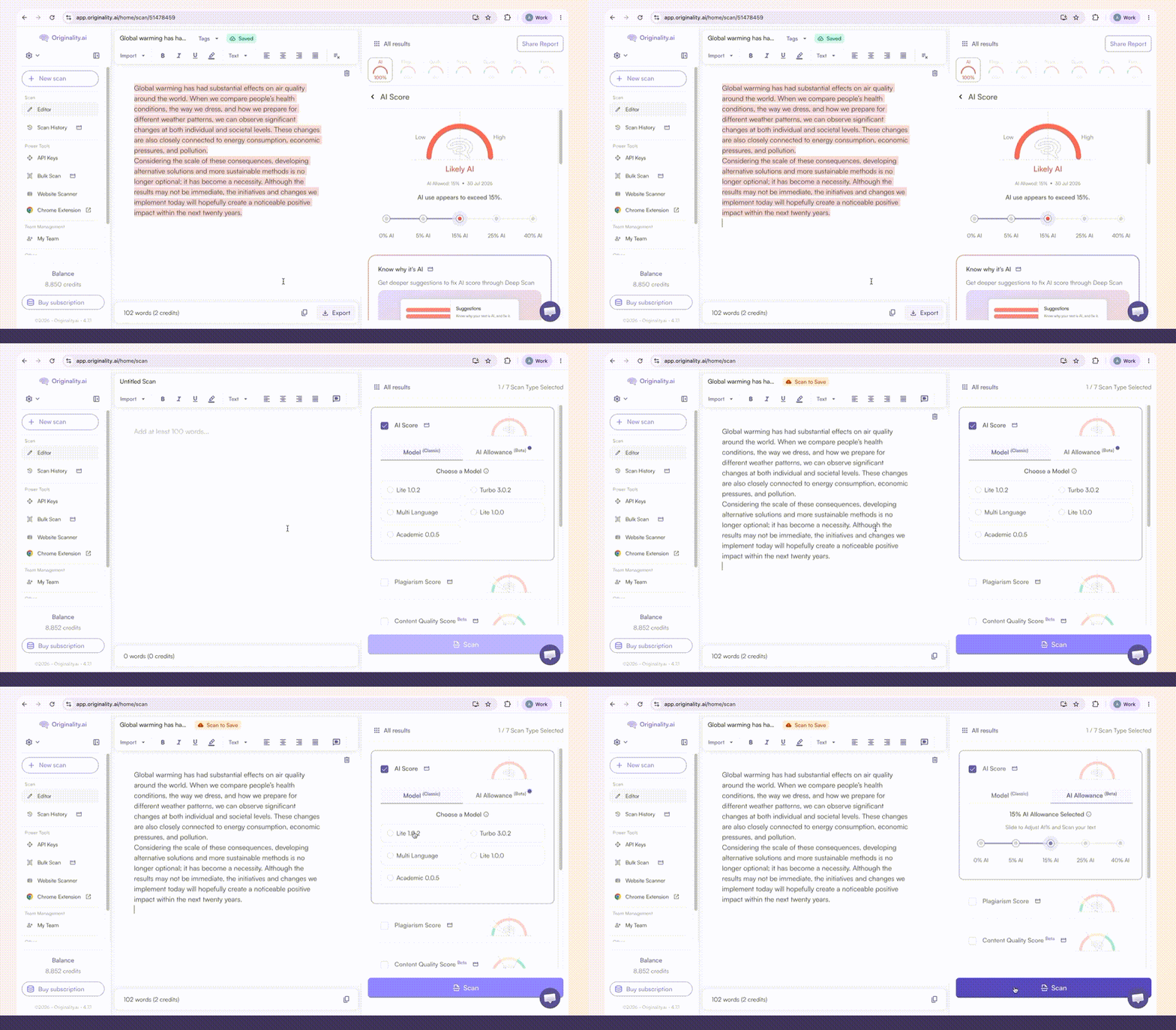
- AI detection with an adjustable AI Allowance, so a project or classroom can define how much assistance is permitted instead of pretending the line is zero.
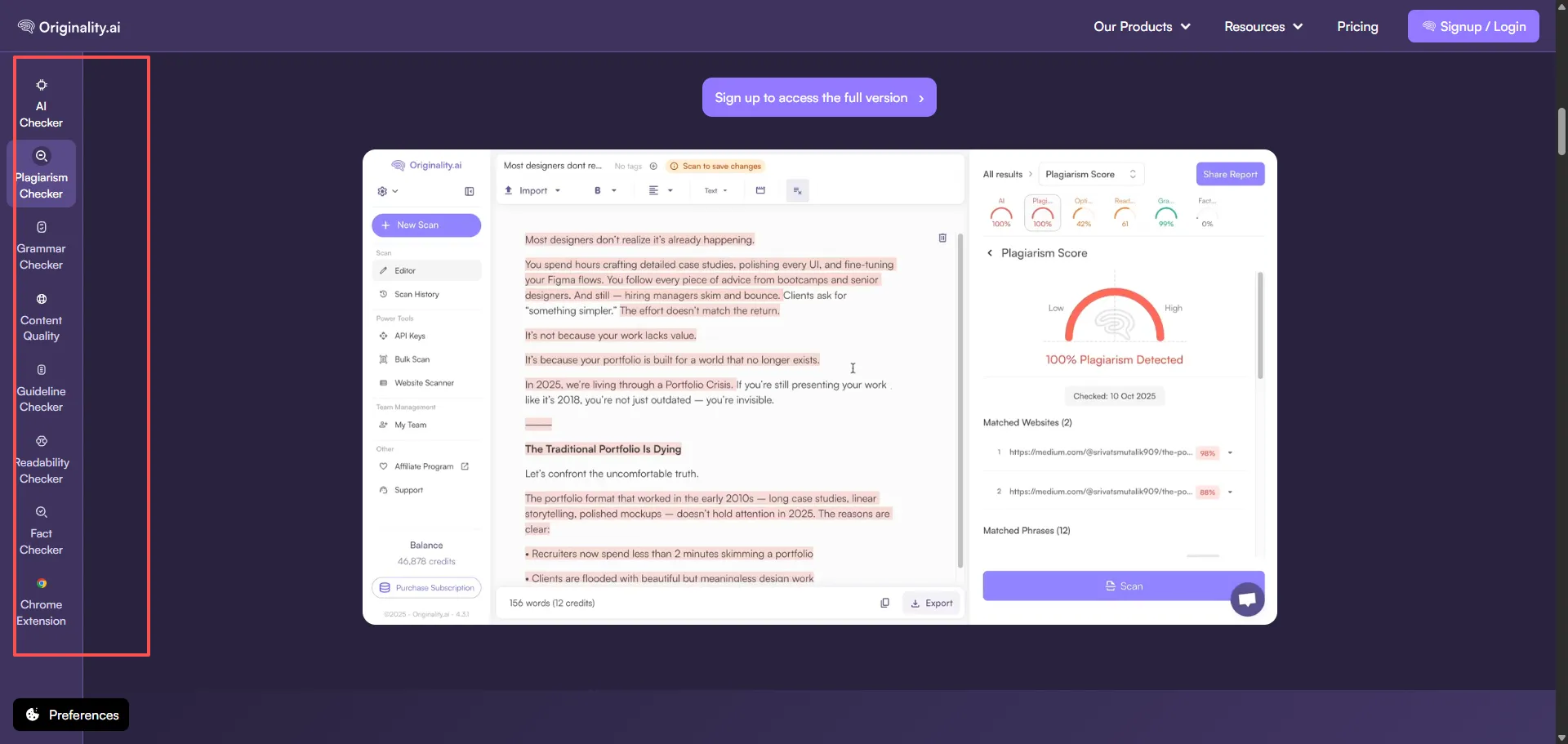
- Plagiarism checking in the same pass, including paraphrase and patchwork cases, so rewritten-source problems and AI signal surface together.
- Writer Replay in the Chrome extension — a sped-up replay of how a Google Doc was actually typed, plus auto-typing detection that separates natural typing from a script pasting text. This is the feature that converts “trust me” into a read-only report someone else can open.
- Bulk and site-wide scanning for auditing an existing content library rather than one document at a time.
- Works where you write — Google Docs, Chrome, a Moodle plugin, and an API for teams that need this inside their own pipeline.
And the limits, because they matter more here than in most categories. The vendor’s own study claims accuracy around 99 per cent; independent benchmarks generally place commercial detectors lower, and false positive rates vary by test set, text type and the writer’s language background. It is one of the stronger tools in a category that is inherently probabilistic. Read every score — including a favourable one — as evidence to weigh, never as a verdict.
🔗 The link below is an affiliate link — if you buy through it, I earn a commission at no extra cost to you. Full disclosure at the bottom of this page.
🔎 Check your own draft before a client or reviewer does.
Free AI checker for short texts · paid plans from $14.95/month · no ongoing free tier for plagiarism scans
What It Costs
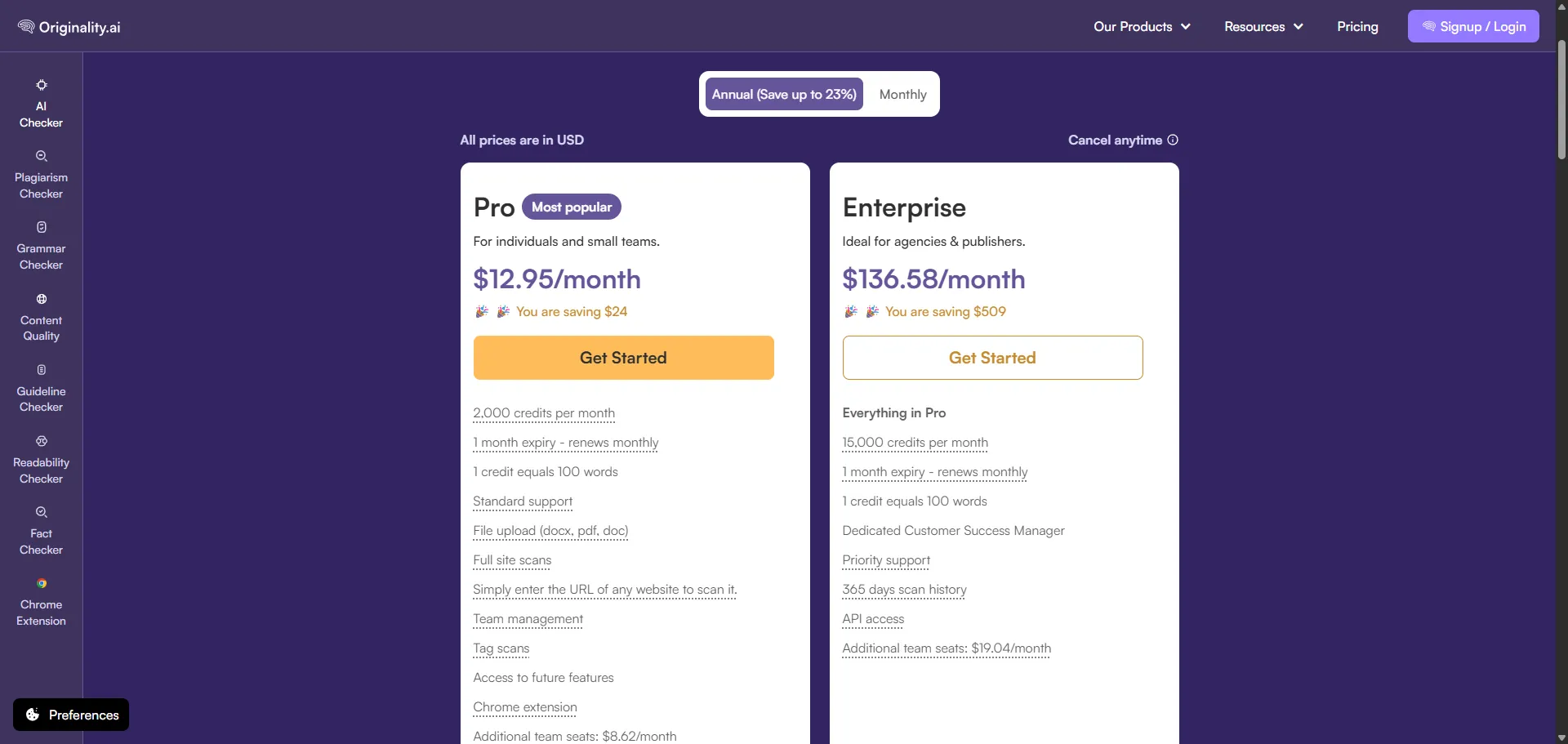
Turnitin does not publish per-seat pricing; institutions negotiate a licence, and individuals cannot buy one. That alone decides the question for most readers. Originality.ai publishes its pricing, and the figures below are taken from the vendor’s public pages in August 2026 and change without notice — confirm before buying. Credits are the unit of account: roughly one credit per 100 words for an AI scan, with plagiarism checks consuming more.
Option
Price
What you get
Best for
Turnitin
Not published
Institutional licence, LMS integration, submissions archive
Schools and universities, via procurement
Originality.ai free checker
$0
Up to 2,000 words per scan, about three scans a day, 100-word minimum. No plagiarism check, no shareable report
Checking one document before you send it
Pay as you go
$30 one-time
3,000 credits, roughly 300,000 words of AI scanning, valid two years
Freelancers with irregular volume
Pro
$14.95/month, or $12.95/month billed annually ($155.40/year)
2,000 credits per month, plagiarism checker, readability, fact and content-quality checks, team management
Regular writers, editors, small content teams
Enterprise
$136.58/month billed annually
Much larger credit allowance, API access, team roles, priority support
Publishers, agencies, schools
Worth paying for if: you commission or hire writers; you deliver work that can be rejected on an AI score; you need plagiarism and AI checking in one pass; you have a content library of unknown provenance to audit; or you have been wrongly flagged before and want a process record next time.
Skip it if: your institution runs Turnitin and will not accept third-party reports — ask what they accept before you pay; you need one check, once, and the free scan covers it; you write fiction or personal essays with no attribution stakes; or you are hoping a tool will show you how to get AI text past a detector, which is not what this is for and not a game worth playing.
📊 Prices, credits and what each plan actually includes.
Pay-as-you-go from $30 · credits valid two years · cancel subscriptions anytime
Why PES 2021 Mobile Is Hard to Download Safely
Frequently Asked Questions
Can students buy Turnitin?
Generally no. Turnitin is licensed to institutions, and access normally comes through your school inside its learning management system. Some institutions enable a self-check option before final submission; if yours does, that is the most useful check available to you, because it is the same engine that will judge your work. If it does not, a commercial detector can only ever give you an approximation of what your institution will see.
Is Originality.ai better than Turnitin at detecting AI?
Nobody can answer that honestly with the evidence available. Both vendors publish their own favourable studies, and independent benchmarks generally report lower figures than either marketing page. Originality.ai has performed strongly on paraphrase-focused benchmarks, and Turnitin has an archive of past submissions no competitor can match. They are optimised for different problems.
Can Turnitin detect paraphrased or AI-rewritten content?
Partly, and this is the known weak point of any engine built on string matching. Reworded text can break the string while the borrowing remains, which is why patchwriting so often returns a low similarity score. Paraphrase-aware and semantic detection catches more of it, but returns judgement calls rather than proof.
Will an AI detector flag writing that is genuinely mine?
It can. Reported false positive rates range from about one per cent to well into double digits depending on the tool, the text and the study, and formulaic or non-native English writing is flagged disproportionately often. Text under roughly 100 words is the least reliable of all. Keep version history — it is your defence.
Does using Grammarly count as AI?
That depends entirely on your institution’s or client’s current policy, and the policies are being rewritten constantly. Two things are true regardless: heavy AI rewriting of genuinely human text can push it over a detector’s threshold, and Originality.ai’s own documentation notes that some rewrite features can trigger false positives. Grammar and spelling correction is treated differently from AI rewriting in most policies — read the current wording rather than assuming.
Do I need a paid checker if my school already uses Turnitin?
Usually not, for coursework. What a paid tool adds is the ability to check before you submit, a shareable report, and evidence of authorship such as a writing replay. That combination is worth paying for when the cost of being wrongly accused is higher than the subscription — which is exactly the position most freelancers and ESL writers are in.
Verdict
Turnitin and Originality.ai are not really competing for the same buyer. Turnitin is an institutional system you are measured by; Originality.ai is a commercial tool you can measure with. If a school is choosing, the deciding factors are integration, archive coverage, staff training and a written appeals route — not a two-point accuracy claim from either vendor. If you are a writer, freelancer, editor or publisher, Turnitin was never on the menu, and the real question is whether you want to see the result before somebody else does.
Whichever side of the scan you are standing on, the same discipline protects you: draft with version history on, keep your process, cite as you go, and treat every score as evidence to be weighed rather than a verdict to be accepted.
✅ Run the check yourself, before someone else runs it on you.
AI detection + plagiarism + writing replay · free AI checker available · paid plans from $14.95/month
⚖ Affiliate Disclosure
Some links on this page are affiliate links. If you click one and subscribe, I may receive a commission from the vendor. This never changes the price you pay and never affects what this page says. I have no commercial relationship with Turnitin. Pricing, credit allowances and features are taken from publicly available vendor information in August 2026 and may change without notice. Accuracy figures attributed to either vendor are that vendor’s own published claims and have not been independently verified here; independent evaluations report different figures. AI detection is probabilistic: no tool, including the one recommended here, can prove authorship with certainty, and an AI score should never be used as the sole basis for an academic or employment decision.