How to Prevent Plagiarism in Blog Posts: A 7-Step Checklist
To prevent plagiarism in blog posts, publishers need to start before the first paragraph is written. If sources, copied quotations, and original observations all live in the same notes document, even a careful writer can lose track of ownership. By the time an editor runs a plagiarism checker, the mistake may already be embedded in the draft.
Table of Contents
ToggleThe safer approach is a seven-step workflow: record every source, separate copied words from your own notes, choose the correct form of attribution, draft from a claim brief, review for patchwriting and self-reuse, scan the final copy, and classify every important match before publishing.
This guide is for publishers, content agencies, editors, and freelance writers. It is based on public writing guidance and product documentation reviewed on September 1, 2026. It does not claim that any checker can prove authorship or guarantee plagiarism-free content.
First, decide what needs attribution
Not every sentence needs a citation. However, “I changed the wording” is not a valid test. Use the ownership of the information instead.
| Material in your draft | Usually needs attribution? | Editorial action |
|---|---|---|
| Exact words from a source | Yes | Use quotation marks or a block quote and identify the source |
| A source’s distinctive idea, argument, framework, or interpretation | Yes | Cite even when fully paraphrased |
| Statistics, study findings, charts, or non-obvious facts | Yes | Link to the original source and record the date or scope |
| Widely known, stable background information | Often no | Confirm it is genuinely common in the intended field |
| Your own earlier article written for another client | Usually yes; permission may be required | Check ownership and reuse terms before recycling it |
| A client’s internal facts | Follow the brief and contract | Verify accuracy and whether the information may be published |
| Your own analysis based on disclosed evidence | Not as a borrowed idea | Make the reasoning visible and cite the evidence underneath it |
When uncertain, leave a citation marker in the draft. It is easier to remove an unnecessary marker during editing than to reconstruct a missing source after publication.
Step 1: Build a claim ledger before drafting
Create a simple source table as soon as research begins. One row should represent one claim you may use.
| Claim or idea | Original source | Exact wording saved? | Intended use | Attribution status |
|---|---|---|---|---|
| What you want the article to say | Author, title, URL, publication date | Put copied words inside quotation marks | Quote, paraphrase, summary, data, or background | Needed, added, checked, or removed |
A useful ledger also records the page number for PDFs, the table or figure number for data, and the date you accessed a page that changes frequently. If a writer cannot connect a sentence to a ledger row, the editor should ask whether it is common knowledge, original analysis, or an unsupported claim.
This habit solves two problems at once. It prevents lost citations, and it gives fact-checkers a map of the draft.
Step 2: Keep source language separate from your own thinking
Do not mix copied text and personal notes in one undifferentiated document. Use clear labels:
- QUOTE: exact words copied from a source;
- SOURCE SUMMARY: what the source argues or reports;
- MY ANALYSIS: your interpretation, objection, example, or recommendation;
- VERIFY: a claim that still needs a primary source;
- DO NOT USE: useful context that cannot be verified or published.
Purdue OWL recommends keeping citation information attached to research notes and marking copied language as soon as it is recorded. That is more reliable than trying to rebuild citations from browser history at the end.
For interviews, save the speaker’s words separately from your observations. For client material, label whether it is approved for publication, background only, or confidential.
Step 3: Choose quote, paraphrase, or summary on purpose
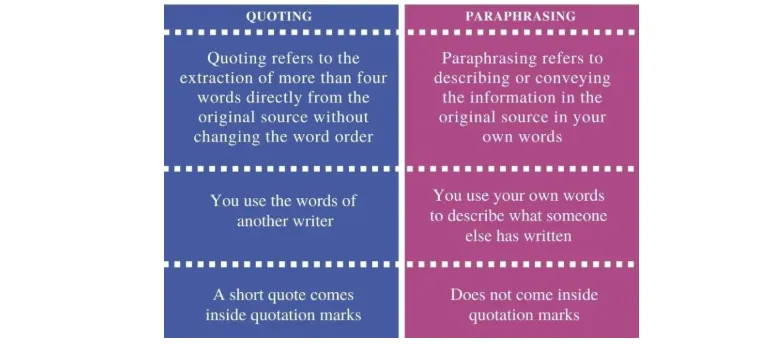
These are editorial tools, not three ways to make copied text look different.
- Quote when the wording itself matters, such as a policy statement or a distinctive definition.
- Paraphrase when the detail matters but the original sentence does not. Rebuild the structure and cite the idea.
- Summarize when readers need the source’s overall conclusion rather than its full reasoning.
A citation does not automatically repair patchwriting. If a sentence follows the source’s order, syntax, and rhythm while swapping a few words, rewrite it from understanding rather than from the open page.
For a detailed reconstruction method, add an internal link here to How to Paraphrase Without Plagiarizing instead of expanding this article into a competing paraphrasing tutorial.
Step 4: Draft from a claim brief, not from an open source
Before writing a section, turn the relevant ledger rows into a short brief:
- What question must this section answer?
- Which facts or sources support the answer?
- What is the writer’s own analysis or recommendation?
- Which wording must be quoted exactly?
- Which uncertainty must remain visible?
Then close the source tabs and draft from the brief. Reopen the sources only to verify meaning, quotations, and citations.
This method reduces sentence-level imitation because the writer is working from a planned argument, not following someone else’s paragraph. It also makes the article more useful: the structure follows the reader’s task rather than the order in which the writer discovered sources.
Step 5: Put attribution where the borrowed material appears
A source list at the bottom does not show which source supports which claim. Place attribution close to the borrowed idea.
For online publishing, descriptive links often work well: name the organization or author and link the exact report, policy, or data page. For academic or client work, follow the required citation style. When quoting, keep the quote short and make clear where your analysis begins.
Check these common failure points:
- a statistic has a link, but the linked page does not contain the number;
- a source is cited at the end of a long paragraph containing several unrelated claims;
- an article links to another blog that merely repeats the original research;
- an image, chart, framework, or code example is reused without credit or permission;
- an AI-generated citation points to a page that does not exist.
The goal is traceability. A reader or editor should be able to move from the claim to the source without guessing.
Step 6: Review for patchwriting, self-plagiarism, and ownership
Patchwriting check
Compare high-risk paragraphs with their sources. Look for the same idea order, clause sequence, unusual phrases, examples, and metaphors. Matching technical terms may be necessary; matching the entire sentence skeleton is not.
Self-plagiarism and client ownership check
Search distinctive phrases from the draft in your own archive or on Google. Writers often reuse introductions, definitions, and product descriptions without realizing that a previous client may own the earlier version.
Asset check
Review screenshots, tables, illustrations, interview material, code, and templates. Text is not the only content that requires attribution or permission.
AI-assisted writing check
Confirm the client’s or publisher’s current policy. AI assistance does not remove the duty to verify sources, and a generated paraphrase still needs attribution when the underlying idea belongs to someone else.
Step 7: Run a two-layer pre-publication audit
The first layer is human review. The second is software-assisted discovery.
Layer 1 — editorial review
- Is every non-obvious claim connected to a source or marked as original analysis?
- Are direct quotations visibly quoted?
- Do paraphrases use a genuinely new structure?
- Are primary sources used where available?
- Has the editor checked ownership of reused material?
- Are confidential drafts allowed to be uploaded to external tools?
Layer 2 — similarity and plagiarism scan
Use a scan to locate passages that deserve attention. Do not use the overall percentage as an automatic pass or fail. A reference list, legal phrase, product name, or properly quoted passage can produce a match without misconduct. Conversely, a heavily reworded idea can avoid a simple string match while still lacking attribution.
How to review a plagiarism report without misreading it
| Category | What it means | Action |
|---|---|---|
| Green: explained match | Proper quote, citation, standard phrase, title, or unavoidable terminology | Confirm formatting; no rewrite solely to lower the score |
| Yellow: needs editorial judgment | Similar structure, weak attribution, secondary-source citation, or repeated boilerplate | Compare with the source and revise or cite |
| Red: publication blocker | Unquoted copying, patchwork assembly, fabricated citation, or reused client-owned text without permission | Stop publication until resolved |
This red-yellow-green method gives an editor a decision trail. It is more defensible than choosing an arbitrary “acceptable plagiarism percentage.”
Where Originality.AI can fit into the workflow
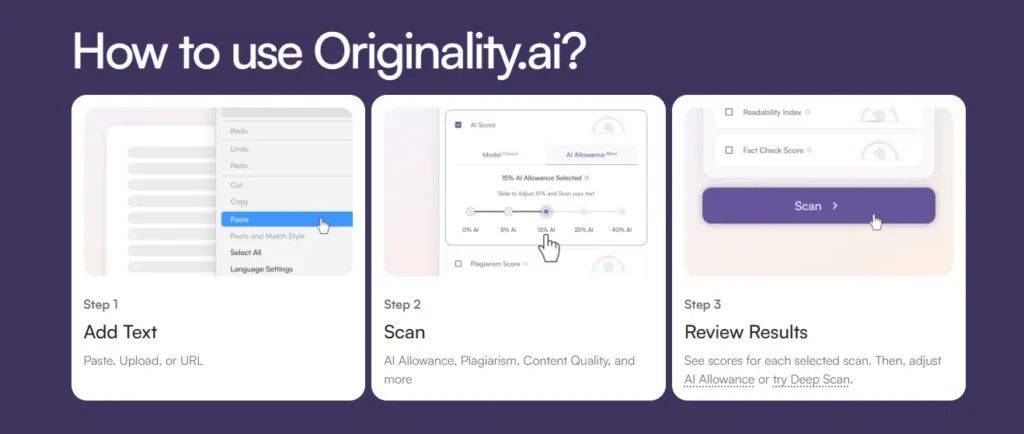
以上七个步骤即可完成。但当出版商或代理机构需要审核大量文章、将匹配项与来源页面进行比对、保存扫描历史记录或与其他审核人员共享报告时,实际操作上就会受到限制。
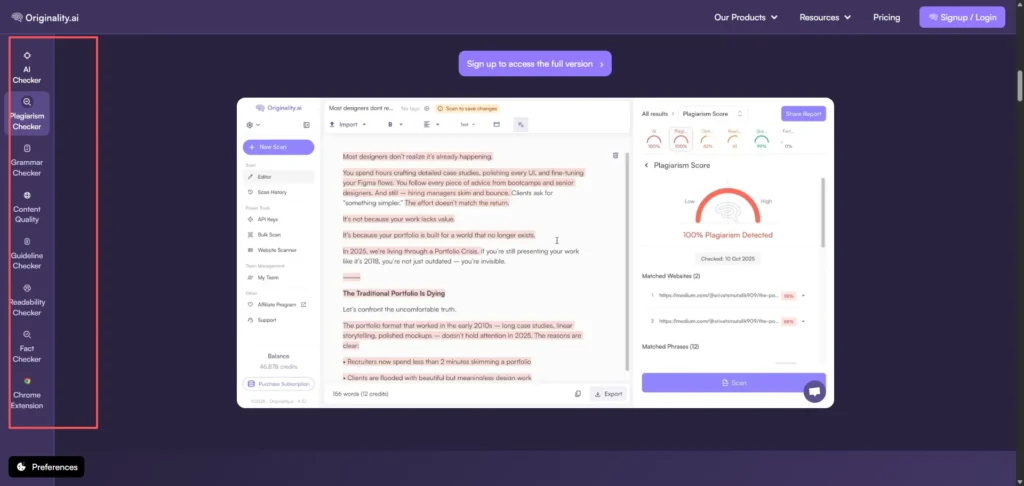
根据其产品页面介绍,Originality.AI提供抄袭检测功能,可高亮显示匹配文字和来源链接,并提供扫描历史记录、PDF和可分享的报告,以及一系列内容质量工具。该供应商还表示,其检测工具旨在检测改写和拼凑式抄袭。该页面上的准确率数据与供应商声明,不能被视为独立证据。
有效的工作流程如下:
- 首先完成人力资源和人力资源审查。
- 确认合同和隐私规则允许上传该草稿。
- 运行查重程序。
- 打开每个重要的匹配来源。
- 将其标记为黄色、绿色、或红色。
- 修改草案或说明为何消耗。
- 保存或分享该报告,作为编辑记录的一部分。
联盟营销声明:以下按钮为联盟营销链接。完整披露信息请见页面底部。
When to skip a paid plagiarism checker
Skip a paid tool, or delay buying one, when:
- you are checking one short, low-stakes document;
- your school or client requires a report from a different system;
- you cannot upload confidential or unpublished client material under your contract;
- your main problem is missing citations rather than finding textual matches;
- nobody on the team has time or authority to review the report;
- you expect a percentage to replace editorial judgment.
A tool is most useful when it supports a defined review process. Without that process, it produces another number for the team to misunderstand.
A reusable handoff checklist for freelance content
Before an editor accepts a draft, require the writer to provide:
- the final document with version history where possible;
- the claim ledger or source list;
- links to primary evidence for statistics and product claims;
- disclosure of reused, licensed, or AI-assisted material;
- confirmation that client-confidential content was handled correctly;
- a response to every yellow or red match found during review.
This creates a consistent answer to the search question “how to check freelance articles for plagiarism.” More importantly, it gives both the editor and writer a fair standard before a dispute occurs.
FAQ
What percentage of plagiarism is acceptable in a blog post?
There is no universal safe percentage. Similarity is not the same as plagiarism. Review the source, context, quotation, and attribution behind each meaningful match instead of relying on one number.
Is paraphrasing plagiarism?
A genuine paraphrase with appropriate attribution is not plagiarism. A paraphrase can become plagiarism when it hides the source of the idea, or when it keeps the source’s structure and merely changes vocabulary.
Do links count as citations in blog content?
Descriptive links can provide attribution for many online claims, but the link must point to the relevant source and sit close to the supported statement. Legal, academic, medical, and client work may require a formal citation style as well.
Can a plagiarism checker detect patchwriting?
Some tools claim to detect semantic, paraphrased, or patchwork overlap, while basic matchers focus on identical strings. No checker should be treated as proof. Compare the flagged passage with the source and make an editorial judgment.
Is reusing my own article plagiarism?
It can be self-plagiarism, duplicate content, or a contract violation depending on who owns the original and what the new publication expects. Check the earlier agreement and disclose or cite the reuse when required.
Is a plagiarism checker the same as an AI detector?
No. A plagiarism checker looks for overlap with existing sources. An AI detector estimates whether text patterns resemble machine-generated writing. They answer different questions, and neither result should automatically determine publication or discipline.
Verdict
The most reliable way to prevent plagiarism in blog posts is to make source ownership visible from research to publication. Keep a claim ledger, separate copied words from your analysis, choose quote or paraphrase deliberately, cite at the point of use, check reuse rights, and treat scanning as discovery rather than judgment.
For one article, a careful manual workflow may be enough. For a publisher or agency reviewing work at scale, a tool such as Originality.AI can make source matching and report sharing easier—but only after the team defines how matches will be reviewed.
Sources and update note
- Purdue OWL — Best Practices to Avoid Plagiarism
- Purdue OWL — Plagiarism Overview
- Originality.AI — Plagiarism Checker
- Originality.AI reference article reviewed for topic research
Last reviewed: September 1, 2026. Product features, policies, and institutional citation requirements may change. Verify the current rules that apply to your publication, client, or school.