
What a 99.9% GPT-6 Astra Detection Rate Really Means
Quick answer: Originality.ai reported that its AI Allowance 15% mode flagged 999 of 1,000 English GPT-6 Astra outputs as Likely AI. That is a strong result for one controlled benchmark. However, it does not mean every GPT-6 document will be detected, and it cannot prove that a particular writer used AI.
Table of Contents
ToggleIn practice, editors, educators, and publishers should treat an AI score as one signal in a review process—not as a verdict by itself.
What this guide adds: a clear distinction between model-level detection, single-document review, authorship claims, and writing quality—plus a five-step workflow for responsible decisions.
What the benchmark tested
On September 4, 2026, Originality.ai generated 1,000 English responses with OpenAI’s gpt-6-astra model through the Responses API. The sample included 200 prompts in each of five categories: blog, conversational, expository, news, and review writing.
The company scanned each final response with its AI Allowance 15% setting. A score of 0.50 or higher counted as detected. Importantly, “15%” describes a detector mode; it does not mean the tool claims exactly 15% of a document was written by AI.
| Content type | Detected / tested | Detection rate |
|---|---|---|
| Blog | 200 / 200 | 100% |
| Conversational | 199 / 200 | 99.5% |
| Expository | 200 / 200 | 100% |
| News | 200 / 200 | 100% |
| Review | 200 / 200 | 100% |
| Total | 999 / 1,000 | 99.9% |
Swipe the table sideways to see all columns.
The single below-threshold result came from the conversational category. Therefore, the result shows high sensitivity to these known-AI samples under the stated conditions.
Still, the study did not include a human-written control group. It does not measure false positives or establish performance on edited drafts, mixed human-AI documents, other languages, short passages, or different prompts and settings.
What 99.9% does—and does not—mean
It supports a model-level claim
The benchmark supports a narrow statement: Originality.ai detected nearly all tested, complete GPT-6 Astra outputs at the chosen threshold. That matters because OpenAI designed GPT-6 Astra for complex reasoning, coding, research, computer use, and document creation.
However, detection performance can change when the input changes. A polished article may combine research notes, human revisions, quotations, tables, and AI-assisted drafts. That is not the same material as a raw model response.
It does not establish authorship
An AI score estimates whether text resembles patterns associated with machine-generated writing. It does not identify who wrote a document, reconstruct the writing process, or prove intent.
Therefore, a reviewer should not turn “Likely AI” into an automatic accusation. A strong process combines the scan with draft history, source checks, version records, interviews, or writing-replay evidence when the stakes are high.
It does not show that GPT-6 writes better or worse
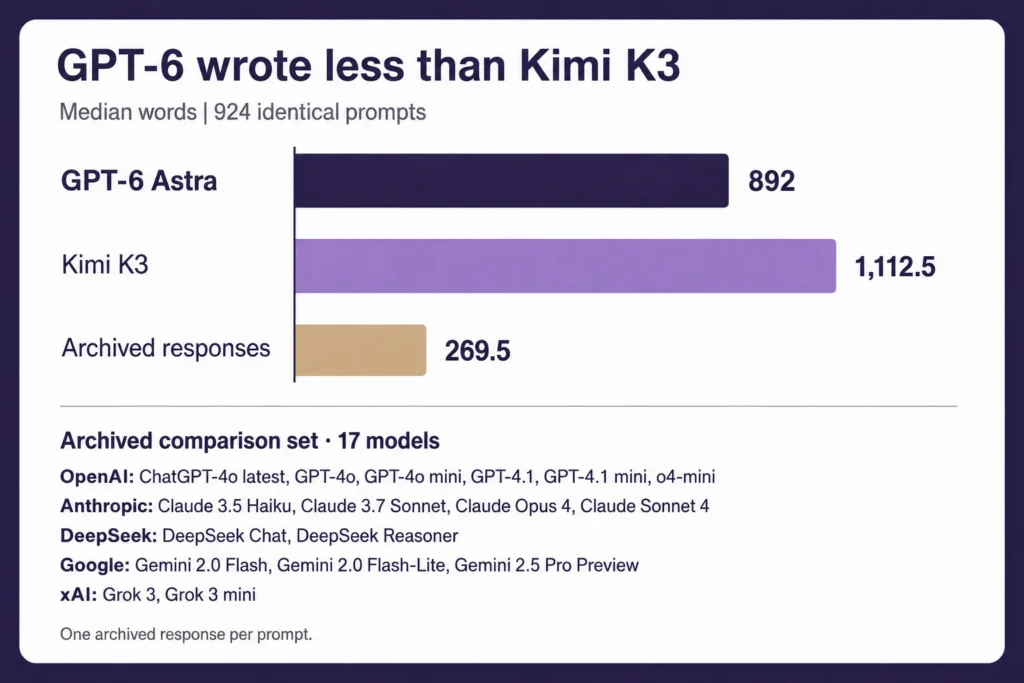
Across 924 unchanged prompt pairs, GPT-6 Astra produced a median of 892 words. Kimi K3 produced 1,112.5, while archived responses from older models produced 269.5.
The median Flesch-Kincaid grade level was 11.0 for GPT-6 Astra, 8.9 for Kimi K3, and 10.2 for the archive. These figures describe length and estimated reading difficulty. They do not measure factual accuracy, usefulness, originality, or overall writing quality.
A responsible review workflow
A good AI-content review answers two questions separately: Does this text contain patterns worth reviewing? And what evidence explains how the text was created?
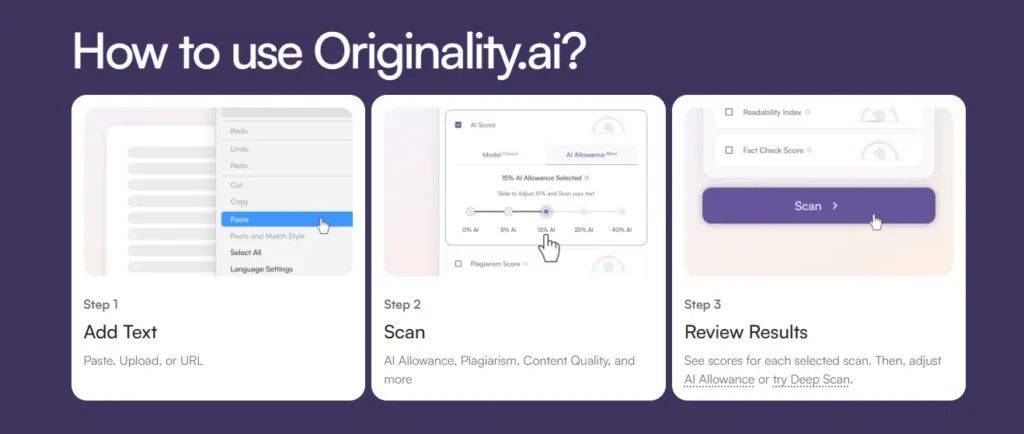
Step 1: Scan enough text
Use the complete draft when possible. Very short passages provide less linguistic context. Keep the original file unchanged so you can compare later revisions.
Step 2: Record the settings
Save the detector mode, threshold, date, language, and document version. A screenshot without those details is difficult to audit later.
Step 3: Review the highlighted evidence
Do not stop at the headline score. Examine the passages that triggered the result. Repeated sentence patterns, generic transitions, formulaic conclusions, or abrupt style changes are prompts for review—not proof of misconduct.
Step 4: Check provenance
Compare the result with sources, citations, document history, tracked changes, and earlier drafts. In a workplace, ask the writer to explain the research and revision process. In education, follow the institution’s policy and allow a fair response.
Step 5: Decide proportionately
A low-stakes editorial check may only require revision. A high-stakes authorship decision needs independent evidence and human review. Document the reasoning instead of relying on one percentage.
Affiliate link — full disclosure below.
When Originality.ai is useful
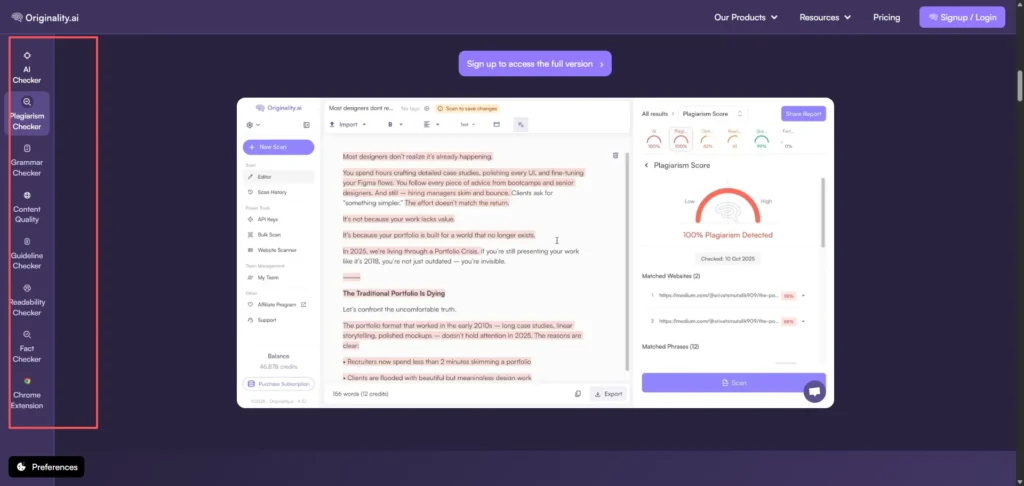
Originality.ai works best as a triage tool for teams that review many documents and need a consistent first pass. It can help editors prioritize manual checks, compare versions, and create a repeatable content-integrity workflow.
- Review high volumes of web content.
- Use AI detection alongside plagiarism, readability, or fact-checking tools.
- Document a screening step before publication.
- Manage contributors under a clear AI-use policy.
Skip it if
Skip a paid detector—or delay buying one—if you only check a few documents, lack a written policy for handling scores, or plan to use the result as automatic proof. First, define what AI assistance is allowed and what evidence reviewers must collect.
Free or low-cost alternatives can support preliminary checks. However, detector outputs are not interchangeable. Do not compare percentages from different tools as if they used the same model, threshold, and calibration.
Limitations and verdict
The 99.9% result is meaningful within a clearly defined test: 1,000 English, known-AI, full GPT-6 Astra responses scanned with one Originality.ai mode and threshold. The large sample and balanced categories make the result more useful than a handful of anecdotal scans.
Still, the detector vendor published the benchmark. It lacked a human control group, so it cannot answer how often human writing might be flagged. It also cannot predict every real-world editing workflow.
Verdict: Originality.ai appears highly sensitive to raw GPT-6 Astra writing in this benchmark. Use the result to justify careful screening, not automatic judgment. Treat the detector as an alert, preserve evidence, and give a human reviewer the final decision.
Frequently asked questions
Can Originality.ai detect GPT-6 Astra?
In Originality.ai’s September 2026 benchmark, the AI Allowance 15% mode classified 999 of 1,000 tested GPT-6 Astra outputs as Likely AI. Results outside that setup may differ.
Does a 99.9% detection rate mean 99.9% accuracy on all documents?
No. The figure describes detection of known-AI samples in one test. Overall accuracy also depends on human writing, edited text, languages, document length, thresholds, and real-world use cases.
Can an AI detector prove that someone used GPT-6?
No. A detector provides probabilistic evidence about text patterns. It cannot establish authorship or intent by itself.
Why did GPT-6 Astra receive a higher readability grade than Kimi K3?
The study found a higher median Flesch-Kincaid grade for GPT-6 Astra, suggesting greater reading difficulty in those samples. The metric does not show that one model writes better or produces more accurate information.
Should publishers scan AI-assisted articles?
Scanning can help when it supports a transparent editorial policy. Publishers should also verify sources, check plagiarism, review changes, and judge the final article for accuracy and reader value.
Sources and update note
- Originality.ai: Is GPT-6 Astra Content Detectable?
- OpenAI: GPT-6 Astra model documentation
- Moonshot AI: Kimi K3 documentation
Last fact check: September 13, 2026. Product settings and detector performance may change.
Affiliate Disclosure
This article contains affiliate links. If you purchase through one of these links, the publisher may earn a commission at no additional cost to you. Affiliate relationships do not change the evidence standards, limitations, or conclusions presented here.